
How worried should HEOR be about its future?
A survey of US pharma HEOR leaders
Peter J. Neumann, ScD,a Grace Hatfield, BA,a Tom Hughes, BScPharm,b PhD, Matt Seidner, BS,a Lu Shi, PhD,b Paige Lin, PhD.a
a Center for the Evaluation of Value and Risk in Health, Institute for Clinical Research and Health Policy Studies, Tufts Medical Center
b Global Medical Affairs and Evidence Generation, argenx
Introduction
In recent years, the field of HEOR has engaged in considerable soul-searching as several large pharmaceutical companies reorganized or downsized their HEOR groups, prompting renewed efforts to demonstrate the field’s value.1-6
Methods
We surveyed senior professionals in US-focused HEOR departments at pharmaceutical companies in May 2026 to understand their views about the field. The survey, which required 5-10 minutes to complete, contained questions about the viability of HEOR, the importance of different value elements, and the role of HEOR in clinical research. This effort builds on our previous work regarding respondents’ views about various health policy topics and organizational trends.7,8
We pilot-tested the survey with four experts in the field and established a larger, convenience sample of HEOR professionals at leading pharmaceutical companies. The sample draws on heads or senior leaders in US HEOR departments at large pharmaceutical companies (defined based on 2024 revenue data and their membership in PhRMA or the National Pharmaceutical Council) and included individuals in selected smaller companies who subscribe to the Tufts-CEVR databases. We invited 102 professionals from 61 companies to participate (one per company, two or more from larger organizations). Sixty-one recipients from 42 companies completed the survey, reflecting a 60% response rate.
Results
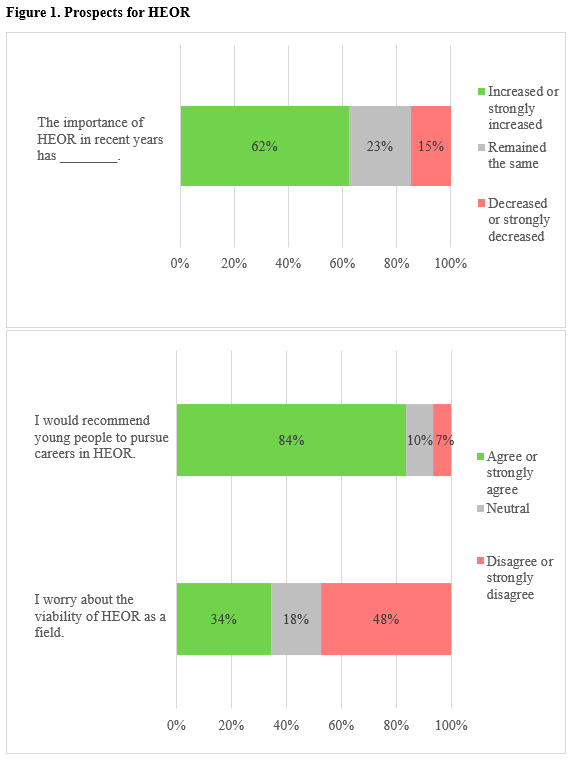
Most respondents (62%) reported that the importance of HEOR has increased or strongly increased in recent years, and a large majority (84%) said they would recommend the field to young people pursuing careers (Figure 1). Thirty-four percent said they worried about the viability of the field.
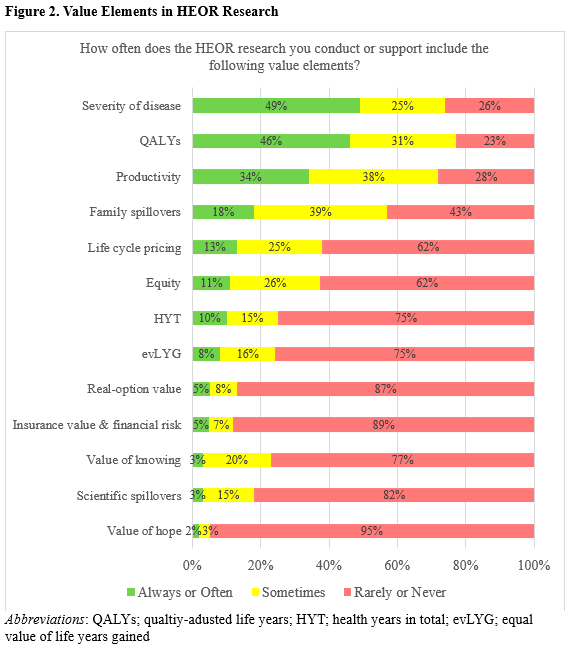
Views about components of value varied across value elements (Figure 2). Four elements – severity, QALYs, productivity, and family spillovers – enjoyed substantial support with over 50% saying that they always, often, or sometimes included such elements in research they conducted or supported. For all other elements, the majority of respondents said they rarely or never included them.
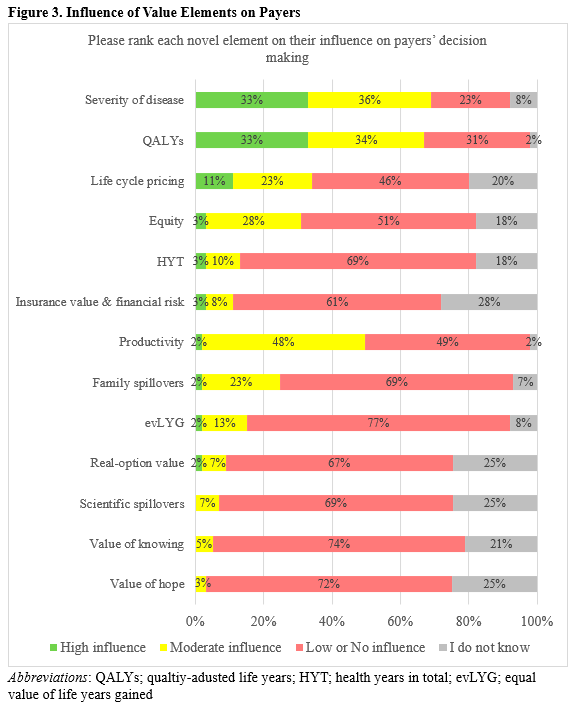
Respondents generally believe that few of the novel value elements influence payer decision making – stating that only severity of disease, productivity, and QALYs had high or moderate influence (Figure 3). For several elements – real option value, scientific spillovers, value of knowing, value of hope – fewer than 10% of respondents said the elements had high or moderate influence.
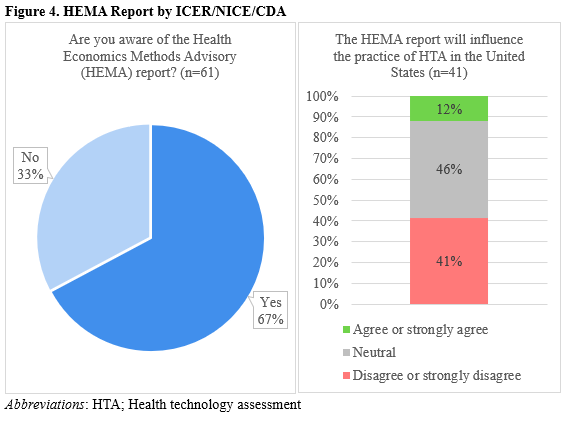
Most respondents (67%) stated that they were aware of the recent report on health technology assessment (HTA) methods issued by the Health Economics Methods Advisory (HEMA) group, jointly sponsored by ICER, NICE, and CDA, but only 12% believed that it will influence HTA practices in the US – 46% were neutral on the projected impact (Figure 4).
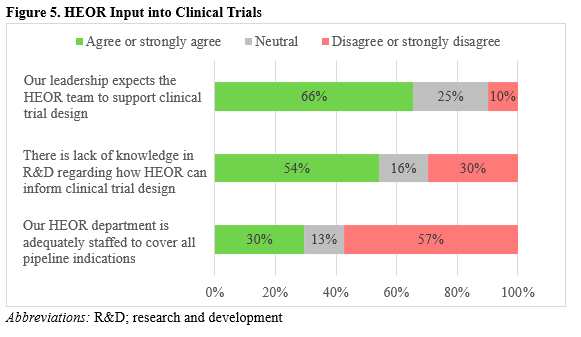
In terms of HEOR input into clinical trials, most respondents (66%) stated that their company’s leadership expected HEOR input into trial design, though a majority (54%) stated that there is a lack of knowledge in R&D departments about how such information can be incorporated (Figure 5). Only 30% reported that their HEOR departments were adequately staffed to cover pipeline indications, a proportion that differed little by company size (data not shown).
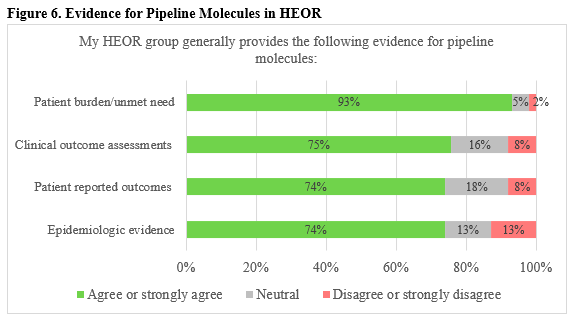
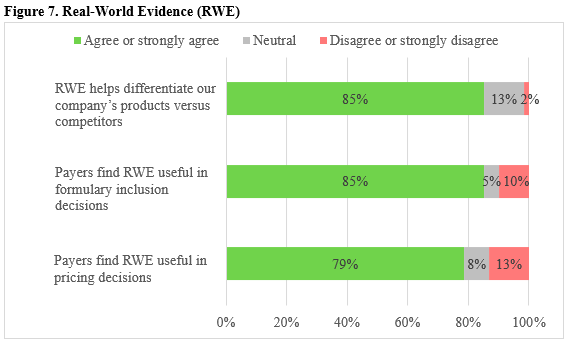
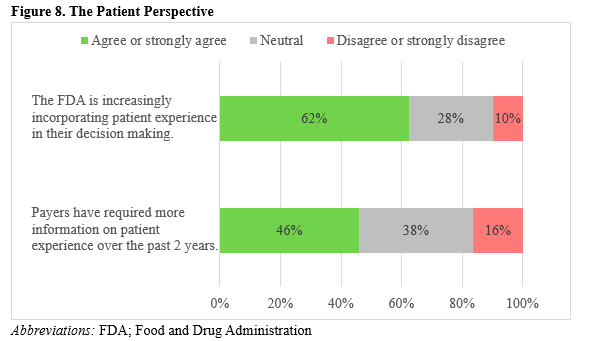
The majority of respondents (70% or higher across the questions) said that their HEOR groups provided input into areas, such as patient burden, clinical outcome assessments, patient reported outcomes, and epidemiological evidence (Figure 6). The overwhelming majority (~80%) also believe that real-world evidence is useful – in differentiating products versus competitors, in informing payer formulary, and pricing decisions (Figure 7). The majority of respondents (62%) agreed that the FDA is increasingly incorporating patient experience into its decision making, but only 46% agreed that payers have required more patient experience information in the past 2 years (Figure 8).
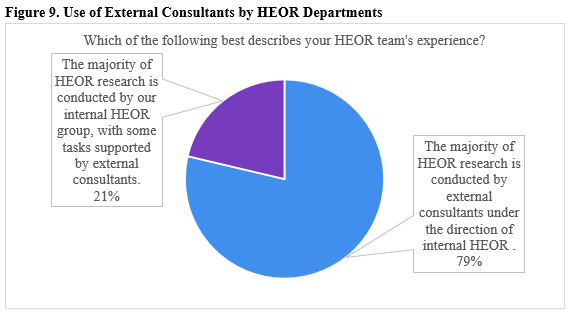
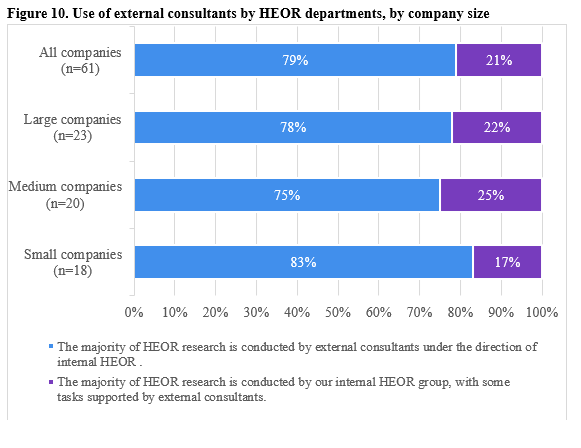
Finally, most respondents (79%) stated that the majority of their HEOR work is conducted by external consultants as opposed to internal teams (Figure 9). These results did not differ substantially by firm size (Figure 10).
Discussion
The survey reveals several notable takeaways:
The outlook for HEOR is broadly positive, despite lingering anxiety. Respondents seem mostly optimistic about the field, believing its importance has increased and stating that they would recommend that young people pursue careers in HEOR. Still, a significant segment (over 30%) is worried about HEOR’s viability. Perhaps the best way to interpret these results is that most respondents are cautiously optimistic, though a sizeable minority remains wary.
Most “novel” value elements have not gained traction. Despite interest in so-called “novel” value elements, most of these items are not being widely adopted. One clear exception is “disease severity,” for which 74% of respondents state they include it in research they conduct or support at least sometimes and 69% say it strongly or moderately influences payer decision making.
Perhaps unexpectedly, there was also relatively strong support for productivity and family spillovers. Also, the QALY metric received relatively strong support, despite the controversy about its use and restrictions in the US (e.g., by CMS in Medicare drug price negotiations), and a perception sometimes expressed that commercial plans care mostly about budgets and member churn. Most other novel value elements seem to have little acceptance in terms of inclusion in research or on payer decision making, suggesting that considerable work will be required to improve their credibility and adoption.
RWE is viewed as influential. The vast majority of respondents stated that RWE is important both in differentiating products and informing payer decisions. More work is needed to explore which specific studies are most helpful and to provide examples where RWE has made a difference, such as informing value-based pricing or formulary decisions based on a drug's effectiveness, safety, and resource use.
There is opportunity for HEOR in informing clinical trials and for adding the patient perspective. In our previous survey, only 39% of respondents (n=59) reported prioritizing HEOR in clinical trial design.8 This current survey suggests that there may be a disconnect between expectations by company leadership and the staffing required to carry out the task. The survey also suggests that patient-centered evidence generation remains underdeveloped.
HEMA’s influence appears limited. Many respondents were familiar with the 2026 HEMA report on HTA methods, but few expected it to meaningfully influence HTA practices (many more were neutral on the matter), suggesting that its recommendations were largely aligned with existing approaches and that HTA bodies are not persuaded about the need to change.
Most HEOR teams, whether from large or small companies, outsource most of their work. While we might have expected that HEOR groups from smaller companies would outsource more of their work, we found little difference in outsourcing by firm size.
Conclusion
Our survey suggests that HEOR has proven resilient, while underscoring the need for continued efforts to increase its value to both internal and external stakeholders. HEOR teams will need to deepen their capabilities in areas such as clinical trial design, methods for incorporating novel value elements, and translating evidence into formats that payers, HTA bodies, and other decision makers find credible and actionable.
At the same time, external pressures—increasingly constrained health care budgets, heightened scrutiny of drug pricing through policies such as the IRA and MFN, and growing demand from regulators such as the FDA and EMA for patient experience data—are likely to increase demand for high-quality HEOR evidence. Meeting that demand will require strong leadership from HEOR groups to effectively define the value of HEOR from phase I to phase IV, and to secure the necessary organizational structure, resources and support.
Acknowledgments
This research was funded by argenx.
References
1. Ramsey S. Big Pharma Says “Thanks, but No Thanks” to Their Own HEOR Groups. Curta; 2024.
2. Thompson D, Dhawan R, Bharmal M, et al. Assessing the Return on Investment (ROI) of HEOR & RWE to the Biopharma Industry: Case Example of Comparative Effectiveness Research. ISPOR 2026. Philadelphia, PA, USA, 2026.
3. Thompson D, Mastey V, Vera-Llonch M, et al. Assessing the Return on Investment (ROI) of HEOR & RWE to the Biopharma Industry: Case Example of Economic Modeling in HTA Submissions. ISPOR 2026. Philadelphia, PA, USA, 2026.
4. Thompson D, Nestler-Parr S, Roberts C, et al. Assessing the Return on Investment (ROI) of HEOR & RWE to the Biopharma Industry: Case Example of External Control Arms in Clinical Trials. ISPOR 2026. Philadelphia, PA, USA, 2026.
5. Thompson D. The Evidence Base: Assessing the return on investment of HEOR to the biopharmaceutical industry. Becaris Publishing. (https://becarispublishing.com/digital-content/blog-post/assessing-return-investment-heor-biopharmaceutical-industry).
6. McElwee NE, Willke RJ, Earnshaw S, Garrison LP, Jr., Pizzi LT. Towards a Vision for HEOR: From Technology Appraisal to Health Policy Science. Value Health 2026 (In eng). DOI: 10.1016/j.jval.2026.05.012.
7. Neumann PJ, Shi L, Hatfield G, Hughes T, Seidner M, Lin P. The Tufts-CEVR HEOR Leaders Survey: Health Policy Challenges and Opportunities. Tufts Medical Center: Center for the Evaluations of Value and Risk in Health. (https://cevr.tuftsmedicalcenter.org/news/heor-leaders-survey-1).
8. Neumann PJ, Hatfield G, Shi L, Hughes T, Seidner M, Lin P. The Tufts-CEVR HEOR Leaders Survey: Perspectives on Organizational Support and Evidence Opportunities. Tufts Medical Center: Center for the Evaluations of Value and Risk in Health. (https://cevr.tuftsmedicalcenter.org/news/heor-leaders-survey-1-trends).